
03 — Maintenance
The part that decides what the other two cost
Installation happens once. Service happens when it is already too late.
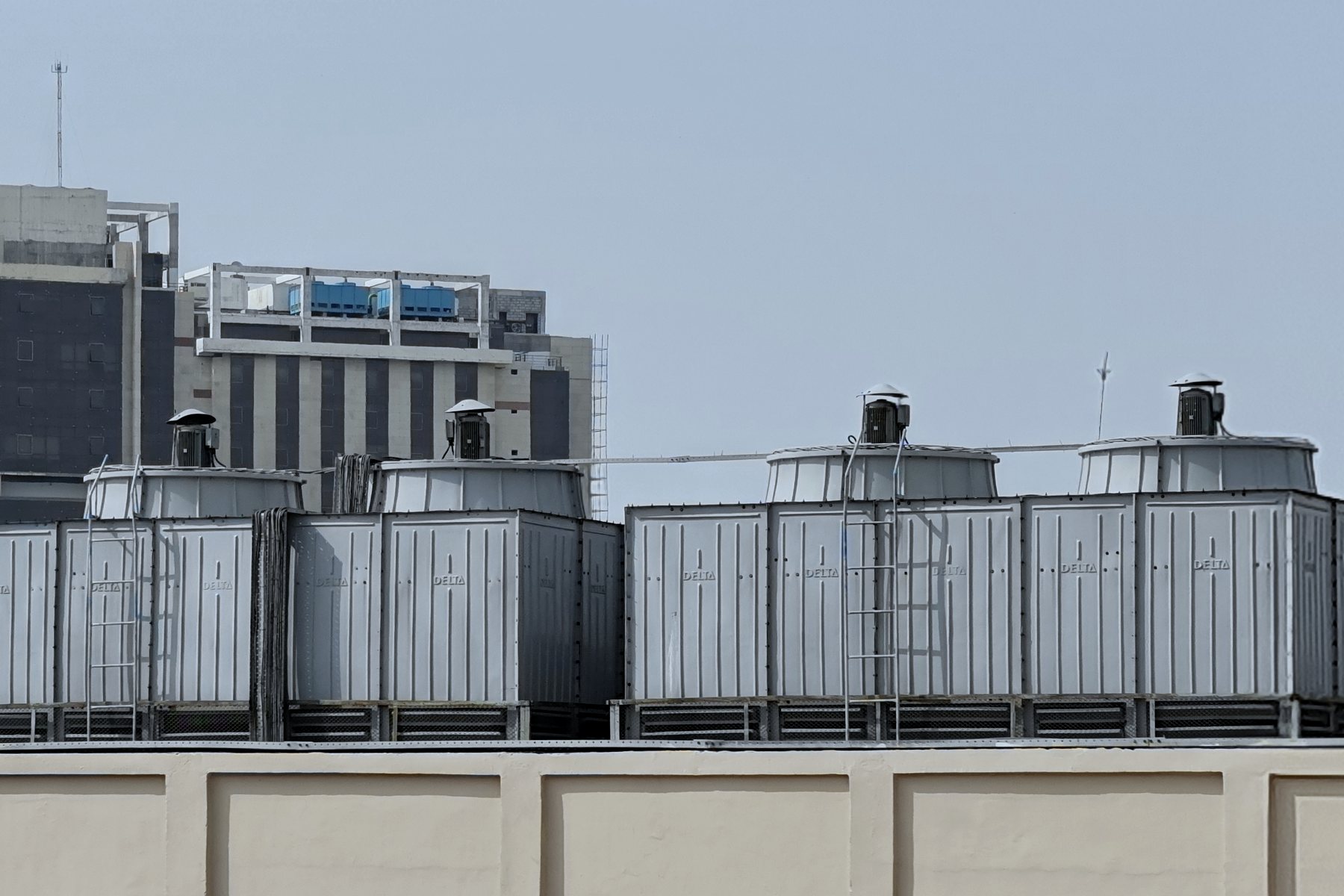
Where the building’s heat actually leaves — and where the water program is won or lost.
Two places to look, not one
Buildings differ: one water circuit or several, an open tower loop or a closed one, condenser water or chilled water — and they are not maintained the same way. Where equipment shares a loop it shares that loop’s temperature, flow and chemistry, rejecting heat into it in cooling and drawing heat from it in heating.
So when a part is replaced and the same fault returns a month later, the cause may be inside the unit — a leak never found, a coil nobody cleaned, a wrong charge — or in the loop it exchanges heat with. We read both before the same part is replaced twice, because a unit judged against a starved loop is not judged at all.
The program fee covers the plant and the loop up to each unit’s branch valve. Work inside a private unit is available on request, quoted separately.
The three fields in your drive that are probably empty
Commercial drive specifications routinely ask for three programmable lockout ranges — speeds the drive is not allowed to sit in. Ask whoever commissioned your drives what is written in them.
What a critical speed is
The running speed at which something the machine generates — once per revolution, twice per revolution, blade pass on a fan, vane pass on a pump — lines up with a natural frequency of the whole assembly: rotor, bearings, motor stand, base, piping, tower steel. That frequency belongs to the machine as installed, not to the catalogue. The same pump on a different base gives a different answer, and an assembly has several modes, each with its own direction.
How we prove it
A speed sweep with a tachometer on the shaft, recording first-order amplitude and phase. Amplitude alone proves nothing — imbalance climbs with speed too. Phase is what proves it: it turns about 180° through the peak, passing 90° at the natural frequency. Then, with the drive and the starter locked out, we bump the structure and read the same frequency back. Two independent measurements landing on the same hertz is the proof. Either one alone is not.
What we do about it
The band is the last step, not the first. Correct what is shaking the machine: balance, alignment, belt tension. If the mode can be moved with a brace or a better support, that is permanent and better. Only where the resonance sits inside a speed range the machine has to work in does it get fenced off in the drive — a low and a high in hertz, the drive ramping through but never resting inside.
How you know it worked
A band is not commissioned when it is typed in. We re-measure first-order amplitude at both edges to show the level has fallen, sweep the reference across the band to confirm the drive refuses to hold there, and check it is live in the building’s own control loop and not only on the keypad. You keep the sweep plot with its phase trace, the bump-test spectrum, the parameter numbers and the readings taken after programming — so the next contractor inherits the number instead of starting again.
Ask any contractor who offers this which analyser they use, and for their analyst’s ISO 18436-2 certificate number. Ask us the same. It takes a two-channel analyser with a phase reference and a tachometer channel, low-frequency accelerometers for tower fan shafts turning 1.7 to 3.3 Hz, and Category II for route and spectral work — Category III for resonance testing and impact analysis. A contractor who cannot name them cannot do the work.
Where it does not apply
Every variable-speed machine gets swept. Only the ones that prove a resonance get a band: programming one into a machine that does not need it throws away turndown for nothing. A band avoids a resonance, it does not remove it, and the machine still passes through it on every start. It costs part of your speed range, and where the resonance sits near the drive’s minimum speed the right answer is usually mechanical instead.
Natural frequency moves with mass and stiffness, so the band is re-verified after a sheave, a motor, a belt retension or an impeller change — and on a tower the basin level is recorded beside the reading. Constant-speed equipment has no band to program, and it can sit on a resonance permanently, which is worse; there the answer is balance, alignment, stiffening, isolation or a sheave change. Chiller compressor drives we verify and document, never reprogram. On a packaged tower we coordinate the parameter change with the manufacturer, because their manual says to. Structural redesign goes to an engineer.
ANSI/AMCA 204-20 warns that leaving a fan running at its shutdown vibration level could lead to bearing failure and to cracking of rotor parts and housing welds. What comes down when the band is set is the alternating load on the bearings and on the seal faces. Where a tonal hum came from steady operation inside that band, it stops, and we show the spectrum before and after. It is not an energy measure: nothing we found supports resonance costing measurable power, and we will not claim it.
What you actually receive
A signed checklist says a task was performed. This says what failed, why, and how it gets closed. One specimen — two more are in the sample portal.
See the other two in the sample portal.
The first 90 days, if you switch
- Week 1 — Handover audit
Every unit in scope photographed, tagged and read. Nothing assumed from the last contractor’s records.
- Weeks 2–4 — Water program reset
Sample first, restore a residual online, then clean. Verified by independent laboratory test.
- Weeks 4–8 — Baseline band
Enough readings to know what normal looks like for your machines, not for the catalogue.
- Week 12 — First quarterly report
Findings opened, findings closed, and the reading that proves each fix.
Three programs
They differ in one thing: how far we go past the repair. Every program is written for the equipment you actually have.
Curious Core
Scheduled maintenance, done properly and written down.
Quoted in the written proposal
- A task schedule built for your equipment, to ASHRAE 180
- Filters, coils, drains, belts, bearings, fan and motor checks
- Refrigerant circuit checks with EPA 608 records
- Water treatment and Legionella control where you have open water
- Readings recorded at every visit, kept in your portal
- A written report after every failure
- Full root cause investigation
- Predictive testing
Curious Guardian
Core, plus a cause behind every failure.
Quoted in the written proposal
- Everything in Core
- A full Root Cause Report on every failure
- QR tag and service history on every unit
- Seasonal changeover and pre-season readiness
- Priority ahead of non-contract work
- Quarterly review with your own readings in front of you
- Vibration and thermal testing
- Trend reporting on every asset
Curious Root Cause
Guardian, plus we find the wear before it becomes a failure.
Quoted in the written proposal
- Everything in Guardian
- Vibration analysis on rotating equipment · semiannual
- Infrared thermography of electrical · annual
- Critical-speed survey and drive lockout — resonance proved by sweep and bump test, the band programmed, verified and written down
- Every asset trended against its own baseline
- Monthly failure trend — proof the fixes held
- Annual program review, frequencies adjusted to the evidence
Systems we cover, on any program
One fixed annual fee per program. Built bottom-up from the task list: hours × rate + materials + laboratory tests. We do not quote ranges, and work outside the program does not proceed without your written approval.
The trend chart further down this page shows the control logic. This is the sheet behind it: what we measure, on what task, against which number, and where that number comes from. Your engineering staff can check every row. Select a row and Fig. 1 re-labels to that parameter.
| Parameter | Task | Baseline | Alert limit — open a report | Action limit — repair or stop | Source of the limit |
|---|
Two unacceptable inspections in a row force a documented frequency review (ASHRAE/ACCA 180-2018 §4.5.3). A limit marked not set is one we will not invent: it is fixed with you, or at the nameplate, before the program starts.
Fig. 1 — Diagnostic trendline vs. corrective action
- 1Report opens — at the alert limit
- 2Fix — root cause corrected
- 3Verified — a new reading proves it
- Projected, if no action
04 — Approach
Why we do not sell a generic schedule
Standard 180 sets minimum frequencies. Where this coast earns more — tower and fastener inspection, coil and cabinet corrosion — we go more often, and the reason is written next to the task.
Salt air
An oceanfront roof corrodes fasteners, fan hardware and panel connections faster than any inland site.
Cooling all year
The plant never gets an off season, so there is no quiet month to defer work into.
Hurricanes
Pre-season readiness before 1 June. Named-storm securing, and a post-storm restart that tests before it runs.
The questions you are going to ask
Am I liable if there is a Legionella case?
The association carries the risk; documentation is what protects it. We run the water program to an ASHRAE 188 written plan, with sampling before any remediation dose and a retest at least 48 hours after normal operation resumes. Every test and every corrective action is kept in your portal, dated.
Are you licensed and insured?
Florida CMC licence, general liability and workers’ compensation certificates are attached to the written proposal. We do not print licence numbers on a web page.
Will my residents notice?
Routine work is done in the plant rooms and on the roof. Anything needing a water shutdown, a lift booking or amenity access is scheduled with you in advance and in writing.
Does the program need anything from my staff?
Three small recurring tasks, and we would rather say so now than surprise you later: a weekly tower walk-by, a weekly check that every leg sees flow, and a biweekly mini-split filter wash. If your staff cannot take them, we price them in.
What happens to the wash water?
It is tested and never sent to a storm drain. Property managers get fined for this; it is in our scope so that you do not.
Who handles the boiler certificate?
We do. We prepare the boilers, hold the records and coordinate the authorised inspector. Whether your boilers are in scope, and on what interval, turns on the building’s classification and the nameplate input — we confirm both in writing before the first inspection falls due.
How do I know you are better than the contractor I have?
Compare the monthly deliverable. Ask your current contractor for the last twelve months of trended readings on any one piece of equipment.